An educational experience & an ideal for life

The goal of education is the personal growth of each student. Even the transmission of culture—one of a school’s core missions—is not the ultimate aim, because it cannot be achieved without the growth of the one receiving it.

Knowledge is a personal conquest that each student undertakes, supported by the presence of a teacher who brings it to life. The aim is for students to truly make their own what they learn—not just to gain “competences” they can use, but to deepen their awareness of themselves and of reality. Everything in the school—the academic curriculum, classroom teaching, and complementary activities—serves this process of growth.

Education happens in the act of teaching, because teaching requires students to go beyond themselves and enter into knowledge of the world. Class becomes a place of dialogue, reasoning, and action—a setting in which students are introduced to the experience of doing science, reading literature, expressing themselves, and speaking a foreign language. This places at the heart of learning the two essential figures: the one who teaches and the one who learns.

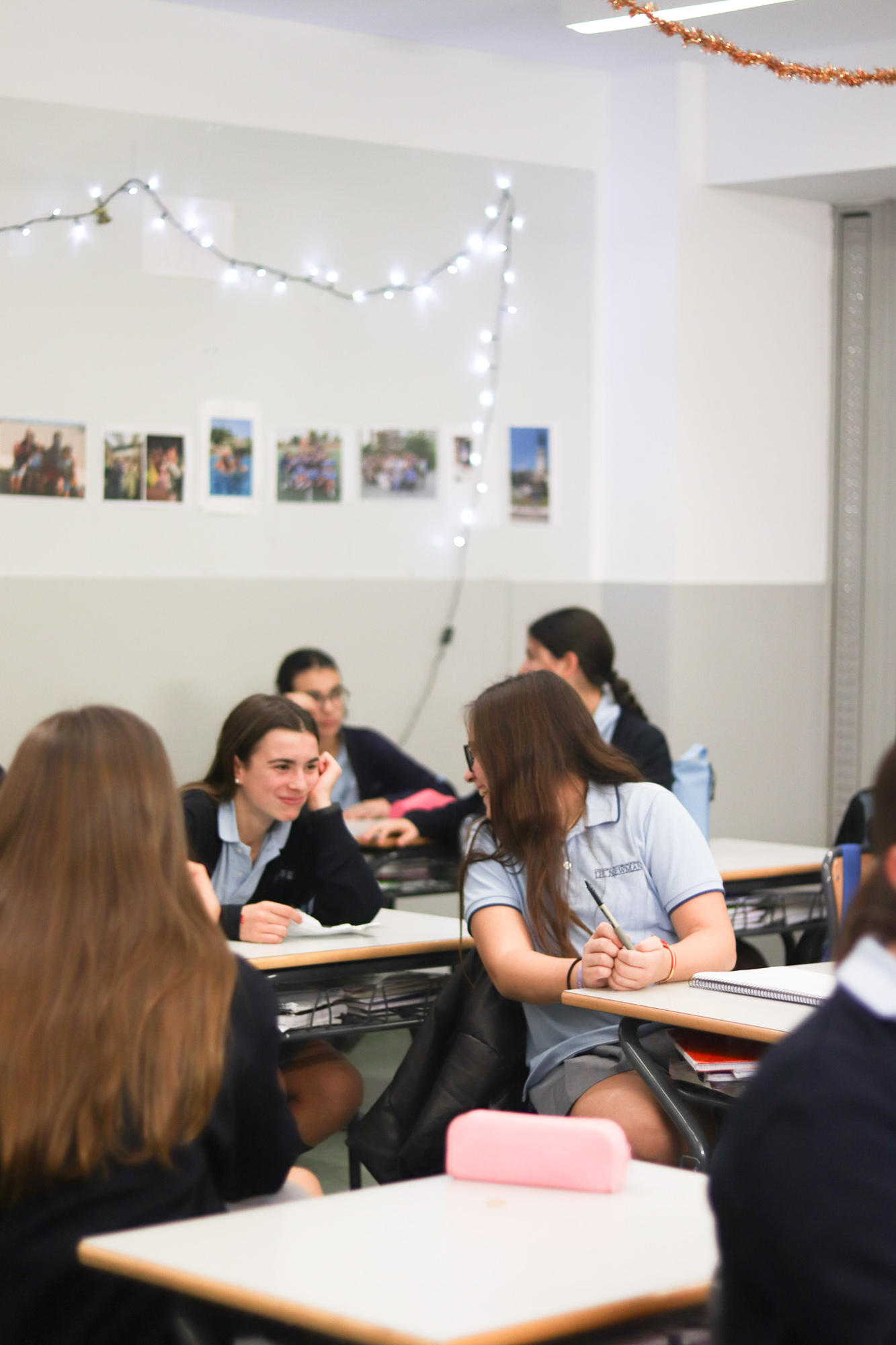
Grupo de alumnas de Secundaria del instituto concertado Madrid trabajando en equipo.

Curriculum structure

A unified and holistic approach

Educational objectives

We aim to awaken in students a love for the truth and a rational desire to seek it—so that this pursuit shapes how they relate to reality.

We educate students to recognize and delight in beauty as a privileged path to discovering truth.

We encourage students to explore the meaning behind the different aspects of reality they encounter or study—so that they can form a personal synthesis between life’s challenges and the knowledge acquired through their education.

We guide students toward a free and responsible use of their freedom—an exercise of the whole person in response to what the intellect recognizes as good.

We promote active participation in school life. Through shared experiences and dialogue, students remain open, curious, and engaged in the world around them.

We introduce students to the core beliefs, values, and attitudes that shape our cultural tradition—so they can critically evaluate and recognize them through the content of each subject.

We help students become more aware of themselves and their deepest human needs for truth, goodness, beauty, and happiness—so they can better evaluate and understand every human experience.

We help students discover the goodness of reality and of human life as seen through the lens of the Christian vision of existence.

Teaching principles

Beauty reveals the splendor of truth and plays a key role in education. Its power to attract opens the way for understanding and valuing what is true. Whether it’s poetry, music, mathematics, art, sport, friendship, or everyday life—we encourage students to contemplate what they study and let themselves be surprised by its beauty.

School life should be marked by an attentive gaze toward beauty. Care for cleanliness, order, attention to detail, and the pursuit of well-crafted work all flow from this vision. Publicly sharing student work is an important way to show that the fruit of personal effort is a gift for everyone.

One of our key goals is to foster openness to reality by drawing students in through the natural attraction of wonder—because it is from wonder that a sincere search for truth is born. We teach students to look, to marvel, to ask questions, and to seek understanding.

Authentic critical thinking comes from this openness to reality. We want our students to be open to everything—but also to engage reason in everything, judging with the deep human needs that guide all our actions: the need for truth, justice, goodness, beauty, love, and happiness.

Real learning happens when students are engaged in reasoning. The teacher presents a working hypothesis and guides the class with these goals:

To engage students personally so they can see the connection between the content, the proposed work, and their own life experience.

To help students make serious and disciplined use of reason according to the method of each subject.

To make class a real act of communication – with an argumentative style that brings the object of study into focus (a text, a physical phenomenon, a historical period, a math problem…), presenting it as something to investigate deeply and meaningfully, raising questions and drawing students towards its ultimate significance.

We’re not interested in teaching study techniques alone—we want to spark a passion for learning and guide students to see study as an adventure of discovering meaning.

Studying involves learning how to use reason according to the method proper to each subject. That means: paying attention, asking questions, understanding, conceptualizing, making connections, synthesizing, judging, and reasoning. These skills develop through the tools we use in class: lessons, textbooks, discussions, exercises, notes, essays, projects, presentations, assigned reading, and cultural activities.

One of our key goals is to support all students, recognizing their individual circumstances and academic needs. A focus on the student’s unique conditions, challenges, and strengths creates a path toward equal opportunity and helps raise expectations for all.

We avoid uniformity. We believe that difference is not a sign of inferiority and that each student’s abilities, challenges, and circumstances are part of their path toward maturity.

Every person is unique and valuable—simply by existing. Each student is free and carries a dignity that does not depend on abilities or academic success.

Activities outside the classroom are an essential part of the curriculum. They are planned with clear academic and educational objectives aligned with our educational philosophy and the specific goals of each subject.

Their educational value lies in the fact that they are offered as gestures—human actions that express, in their very form, the meaning behind them. Teachers prepare and guide every aspect of these activities, accompanying students closely rather than simply organizing events.

Study trips are particularly important. These trips follow a structured program and often include on-site classes. All year groups take part in these trips. In the final year of ESO, students participate in an exchange with a partner school in Italy. In Bachillerato, students travel to London and Oxford, visiting key locations in the life of John Henry Newman.

We firmly believe that parents are the primary educators of their children and that they entrust them to the school as partners in this task. With that trust, the school fulfills its academic mission in accordance with the identity and vision expressed in its educational project.

True educational growth happens only through collaboration between all the key participants—students, families, and teachers. That’s why our relationship with families is marked by openness, warmth, and a spirit of availability. The school provides multiple ways for families to stay connected and engaged. One of our most valued initiatives is the Encuentro de Familias, a regular event that strengthens our shared educational journey.

Discipline is the opposite of acting on impulse. It helps students take reality seriously and engage with its meaning—making it a tool for personal growth.

A student’s personality develops as they grow in their ability to judge and choose freely. But true freedom requires a criterion for judgment. The most human criterion is the one rooted in our nature: the set of deep needs that arise in every human experience—the need for truth, goodness, beauty, freedom, justice…

Discipline fosters the kind of educational relationship that helps students recognize and respond to those needs in the context of daily school life.

Discipline is not an end in itself. It is a condition that allows learning to take place. Rules for behavior and community life are rooted in the values they represent—such as punctuality, order, cleanliness, attention, silence, and respect—and they create the conditions in which our educational mission can flourish.

Educational programs

Chromebook project

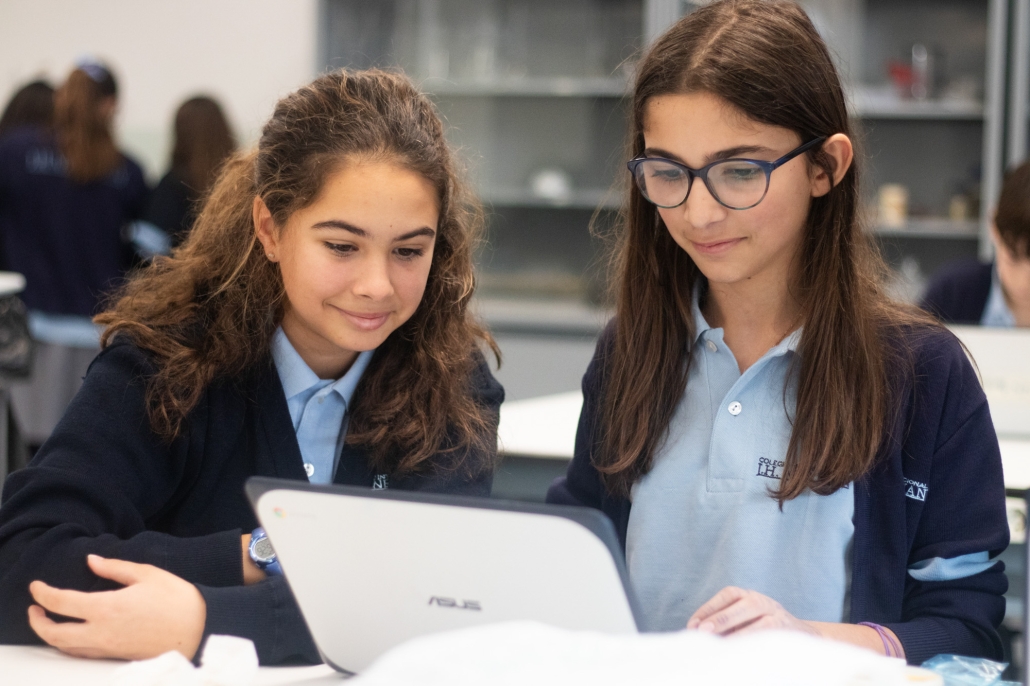
Using digital devices in the classroom helps students develop a responsible and purposeful relationship with new technologies. The benefits are many. Working with Chromebooks supports the development of key skills such as learning how to learn, digital literacy, collaboration, and increased motivation and engagement with academic work.

Science club

This is a space for students who want to go further in understanding the material world and how it behaves. It’s a place to investigate and experiment with different aspects of the reality that surrounds and constitutes us—from the infinitely vast to the infinitely small. In truth, the Science Club begins in the classroom. Through daily lessons, students who are curious to learn more are given time, resources, and support to explore beyond the standard curriculum.

Current affairs observatory

A place to create, propose, ask questions, and discuss current issues—together with classmates, teachers, and invited guests. Students take part in research and projects that explore different aspects of Spanish and global affairs. When needed, subject-matter experts are invited to engage in dialogue and share their insights. Students also reflect on and discuss the day’s most important news stories by reading Spanish newspapers, analyzing and comparing different perspectives.

Art & Science week

This week-long celebration allows us to enjoy, present, and explore more deeply the subjects we’ve been studying all year—with greater creativity and expression. It reflects our students’ growing passion for the disciplines we work on throughout the year.

The week includes two major strands:

  • Academic exploration, aimed at specific groups of students, includes guest lectures from leading experts, contests, and hands-on workshops.
  • Creative expression, open to the entire Newman community, includes exhibitions, student concerts, science fairs, and entrepreneurship showcases.

Science labs

Our science laboratories are fully equipped to give students hands-on experience with the core principles of physics, chemistry, and biology. Practical experiments are integrated into lessons and aligned with the material being studied in class.

Arts and music projects

Our school embraces beauty as a privileged path to knowledge. That’s why we integrate the education of perception into all year levels across the curriculum. Projects such as the school choir, literature contest, short film festival, and student art exhibitions are concrete expressions of this vision.

The arts program at Newman values research as a fundamental tool in the creative process. Many of our projects are developed in collaboration with professional artists and national or international institutions.

Estudiantes de ESO del institutos concertados Madrid participando en una dinámica educativa.

¡Descarga el folleto del Colegio Newman!

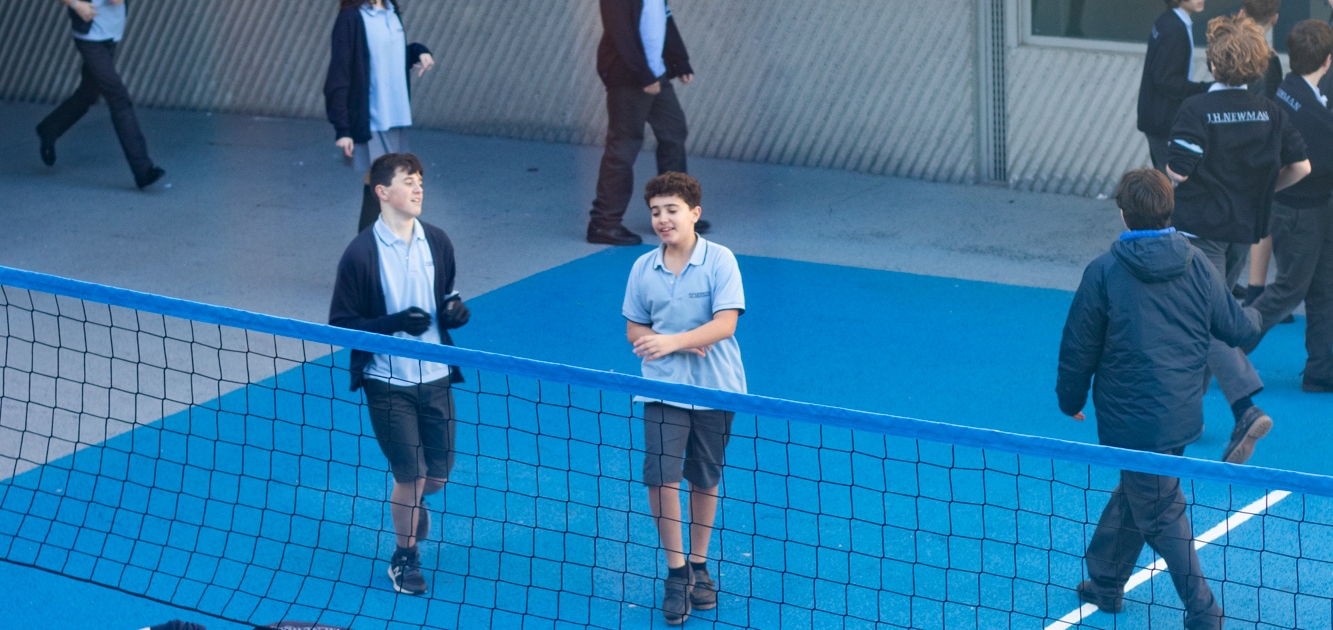
Patio de recreo utilizado por estudiantes de los institutos concertados Madrid durante sus descansos.

Secundaria Newman | Offer Itinerary

ITINERARY

Spanish Language

Mathematics

English

Geography and History

Physical Education

Biology and Geology

Visual and Audiovisual Arts

Music

Religion

Elective (choose 1):

  • Italian
  • Spanish Language and Literature Reinforcement
  • Math Reinforcement

ENRICHMENT OF THE NEWMAN CURRICULUM

The J. H. Newman School enriches the official curriculum with the following proposal, approved by the Autonomous Community of Madrid, within the Schools Autonomy Framework:

Increased teaching hours in the subject of English language and smaller groups.

Increased teaching hours in the subject of Mathematics and Spanish Language and Literature.

ITINERARY

Spanish Language

Mathematics

English

Geography and History

Physical Education

Physics and Chemistry

Technology and Digital Skills

Visual and Audiovisual Arts

Civic and Ethical Values Education

Religion

Elective (choose 1):

  • Italian
  • Spanish Language and Literature Reinforcement
  • Math Reinforcement

ENRICHMENT OF THE NEWMAN CURRICULUM

The J. H. Newman School enriches the official curriculum with the following proposal, approved by the Autonomous Community of Madrid, within the Schools Autonomy Framework:

Increased teaching hours in the subject of English language and smaller groups.

Increased teaching hours in the subject of Spanish Language and Literature.

ITINERARY

Spanish Language

Mathematics

English

Geography and History

Physical Education

Biology and Geology

Physics and Chemistry

Technology and Digital Skills

Music

Religion

Elective (choose 1):

  • Italian
  • Project

ENRICHMENT OF THE NEWMAN CURRICULUM

The  J. H. Newman School enriches the official curriculum with the following proposal, approved by the Autonomous Community of Madrid, within the Schools. Autonomy Framework:

Increased teaching hours in the subject of English language and smaller groups.

Increased teaching hours in the subject of Spanish Language and Literature and smaller groups.

Smaller groups in the subject of Mathematics.

Music is taught in English.

ITINERARIO

Spanish language and Literature

English

Geography and History

Physical Education

Mathematics (A or B)

Religion

Subject pathways:

Scientific Pathway:

  • Biology and Geology
  • Physics and Chemistry
  • Technology or Italian

Humanities Pathway:

  • Latin
  • Economics and Entrepreneurship
  • Artistic expression or Italian

Elective (choose 1):

  • Classical Culture
  • Project

ENRICHMENT OF THE NEWMAN CURRICULUM

The J. H. Newman School enriches the official curriculum with the following proposal, approved by the Autonomous Community of Madrid, within the Schools Autonomy Framework:

Increased teaching hours in the subject of English language and smaller groups.

Increased teaching hours in the subject of Spanish Language and Literature and smaller groups.

Increased teaching hours in the subject of Mathematics and smaller groups.

The Music project is conducted in English.

Would you like to get to know Colegio Newman?