LANGUAGES AND
MULTILINGUAL PROJECT
J.H. NEWMAN INTERNATIONAL SCHOOL

OUR GOALS

Learning a language is not only to master a language – it’s not a mechanical process. It implies a greater dimension: learning about their culture and history. Therefore, at Newman, we implement the teaching of languages through its tradition and literature. We consider it essential to the learning of a second language from a historical or literary context and at the same time, relatable to our students.

We encourage immersion in the language through different daily activities encouraging students to learn in a natural, real, and experiential way, within a meaningful context. Outings and other complementary activities further reinforce the use of language in situations beyond the classroom.

From Early Childhood Education onwards, we introduce new language through engaging, age-appropriate activities such as games, songs, drama, role-plays, activities, arts and crafts…
Opening up to new possibilities and experiences is what allows a school to evolve continuously, innovate, and avoid being carried along by the inertia of what has already been established.
We want to make international education accessible, attractive and easy to embrace. We are interested in both students and teachers considering their learning possibilities as multiplied when they open themselves to the world.
Our goal is to train people who are passionate about reality in all its dimensions, who understand their connection to the world, and who feel a sense of responsibility towards building a better world.
Why do we educate, if not to prepare for the world? School is a place to prepare people for life in the world. We cannot prevent them from engaging with the world – with its challenges, principles and truths – when the time comes; what we can do is prepare them for the inevitable. And no one ever learns to swim in troubled waters without ever stepping into them. (J. H. Newman)

At our school, English is not just another subject. From Early Childhood Education, through Primary, Secondary and Baccalaureate, our students experience a full process of immersion – from oral communication to written expression. By the end of their education with us, they reach a very high level of English or pursue further education abroad.
Complementary activities are tailored and coordinated by our teaching staff with the aim of strengthening classroom learning at every stage and to give opportunities to students with higher proficiency. Activities such as English-language plays, visits to museums and outdoor excursions conducted in the English language all to encourage deeper immersion.
Our English language programmes place special emphasis on catering to the diversity of students, recognising the uniqueness of their individual objectives. We have additional teaching staff to create smaller groups, allowing a more individualised and efficient attention.
We are an official Cambridge examination centre for Secondary students, ensuring the quality of our teaching. By the end of Primary (Year 6), students achieve the B1 level (Cambridge PET), while Secondary students obtain the First Certificate (B2) and Advanced (C1).
Bilingualism in Early Childhood Education
In Early Childhood education, our teaching follows a communicative approach in which English becomes the main medium of communication between teachers and students. Little by little, through games, songs, stories, role-plays, activities, arts and crafts, dances, and other activities, children begin to use English naturally with their teachers and peers.
We complement this process of acquisition and learning with a synthetic approach to early literacy, combining our own method with “Read and Write, Inc.”, which continues into Primary with a focus on writing skills.
Through careful planning, engaging activities and a motivating atmosphere, our teachers make the most of the time students are exposed to English, ensuring effective and enjoyable learning.
Bilingualism in Primary Education
Building on the foundation from Early Childhood Education, teachers in Primary Education – especially in the first cycle (Years 1 and 2) – maintain a playful, oral-based approach to literacy.
A third of the school day is conducted in English by qualified teachers with advanced linguistic competence, ensuring the most is made of every English-learning opportunity, whether with the main teachers or language assistants.
In Primary, we have also innovated English teaching by splitting all daily English sessions into smaller groups, allowing for more personalised instruction that takes into account the diversity and needs of each class.
English learning is enriched through culture and literature, avoiding purely mechanical learning. We consider it essential to the learning of a second language from a historical and literary context that is also relatable to students. Students expand their vocabulary, grammar, historical and scientific knowledge and literary understanding, while developing fluency, pronunciation and written expression.
In addition, “Sports” is a subject taught by a native American teacher, encouraging students to express themselves and to use English in a natural way.
English in Secondary and Baccalaureate
In Secondary School and Baccalaureate, students receive more English instruction than the legal minimum. From CSE and later in Baccalaureate, the English language programmes are aimed at maintenance and refinement of the level acquired. These programs also consider the diversity of students, recognizing the distinction between core learning goals and individual objectives.
The curriculum is designed to maximise practices across different language skills: speaking, listening comprehension, written expression, reading comprehension, vocabulary and use of grammar.


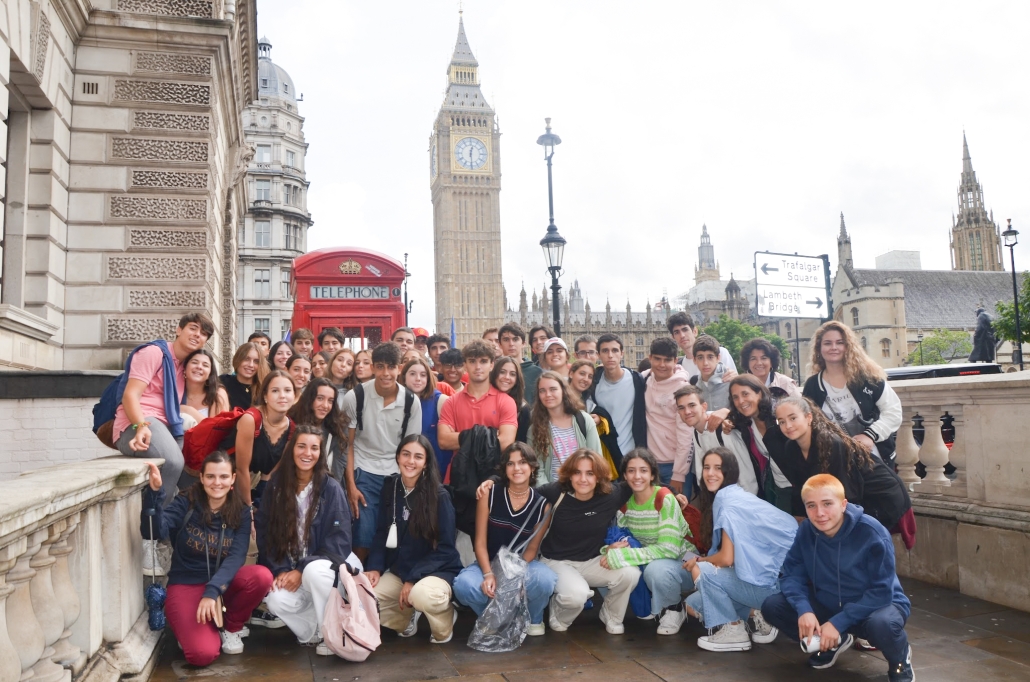
From Year 6 onwards, the school offers students the chance to stay in Ireland, England and the USA either during the school term or in the summer. The main objective is to strengthen their English language skills through full immersion in an English-speaking environment, with programmes tailored to each student’s case.
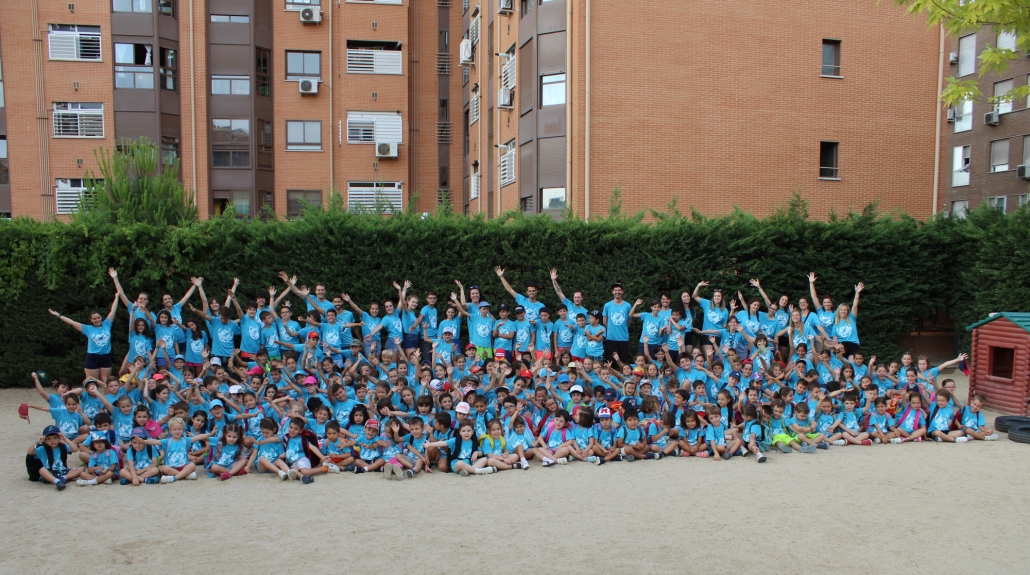
For pupils in Early Childhood Education and Primary, the school organises a Summer Camp during the month of July. Each year’s activities, trips and workshops follow a different theme and allow a total immersion in the English language.
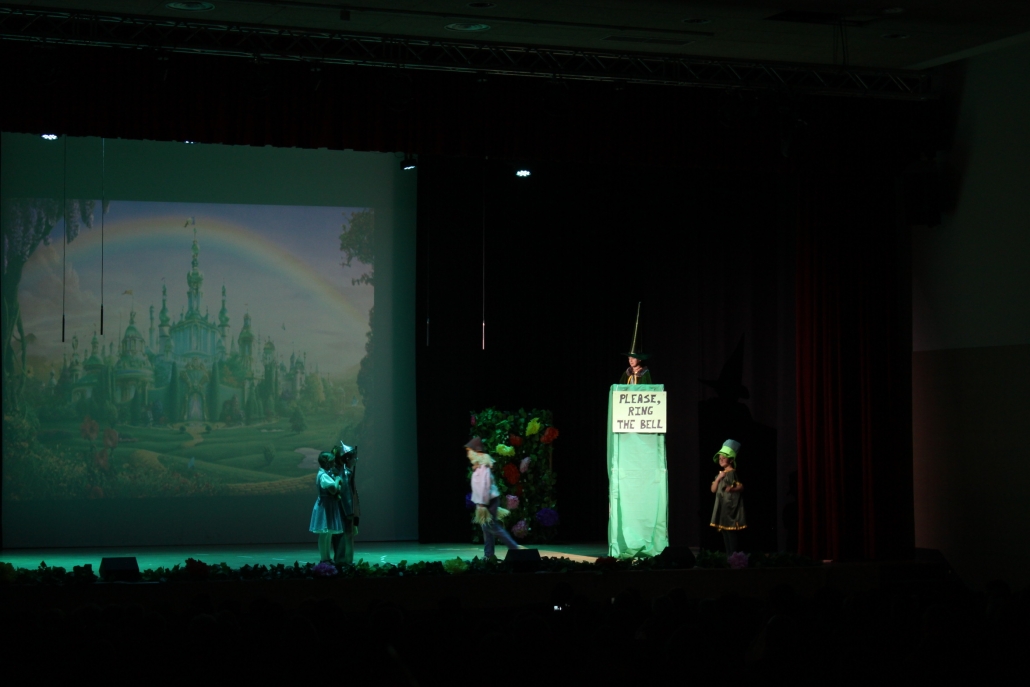
In Year 4 of Primary, pupils perform The Wizard of Oz in English. It is performed in April and shown to all parents. Preparation begins with reading and working through the book in class, followed by rehearsals and staging the production.
Every year, we hold Masterchef Newman, a Year 6 English project that has become a true competition. Running for over 12 years, it aims to help pupils use English naturally and continuously while learning food and recipe vocabulary, while having fun. The students are divided into 15 groups, each designing and preparing a menu. A jury votes on a winning team. All of it, from planning to presentation, is done in English.
In Secondary and Baccalaureate, students regularly take part in paired speaking and conversation sessions, where teachers assess their oral skills and progress.
Italian is the language of arts, music and gastronomy. At Newman, we offer students the chance to study a foreign language that is both easy to understand and easy to learn.
In class, our students are prepared for official exams such as the CILS (the Certification of Italian as a Foreign Language) and the EVAU (the Spanish University entry exam) through a communicative approach with which they can practice the 4 skills:
Understand and express themselves both orally and in writing, reaching levels B2 and C1 which allows them to raise the average EVAU to achieve their goals.
In keeping with our motto to open students up to the world, 4th CSE students take part in a study trip to Italy, staying with host families for a full immersion experience.
Some students also stay for two or three months in an Italian school, which in turn sends their pupils to spend a term at our school.
We also run collaborative projects with Italian schools, including letter exchanges, Padlet activities and group work via the eTwinning platform.
It is one of the minority languages in terms of speakers, but precisely for this reason we know that specialising in it brings many benefits. Many of our alumni have studied at Italian universities through Erasmus programmes, while others have gone to work in Rome, Milan, Florence…
Finally, others need Italian for competitive exams or advanced studies such as doctorates and master’s degrees.

Year 12 pupils exchange messages with their peers in Italian schools about topics that interest them, using the Padlet app. This project improves their written fluency by allowing them to talk about topics that they love and have in common, and in addition, make virtual friends!
Each course we have the opportunity to have among us 3 or 4 Italian assistants who work with Year 1 of Baccalaureate students and support the Italian department at Newman. They are language assistants who join us for a term, helping to enrich students’ conversational skills. In addition, they give a cultural presentation about their country or city.

Our school is registered on the e-Twinning platform and has carried out an international pen-pal exchange with the Italian school Liceo Giuliano della Rovere (Savona).

We offer intensive Spanish language courses for students from the international schools we work with. We offer a language course, guided tours and accommodation in family homes.

As part of our extra-curricular activities, we also have a Language School where we offer English, French and Italian. You can visit our extracurricular section to learn more.
Why does language learning at J.H. Newman International School go beyond simply ‘teaching English’?
At J.H. Newman International School, we believe that learning a language is not merely a mechanical process: it involves understanding its culture and history, which is why we also draw on tradition, reading and literature, seeking a historical or literary context that is relevant to the pupils.
How can we get students to use the language in real-life situations (immersion)?
Through an immersive approach to spoken and written English, based on everyday activities that are relevant to the pupils, enabling them to learn ‘in a natural and authentic way’, supplemented by field trips and additional activities outside the school setting. Furthermore, English teachers speak exclusively in English in all contexts, whether inside or outside school.
What English language qualifications are available?
Our international school in Madrid is an official Cambridge examination centre for secondary school students; in Year 6 of primary school, pupils can take the B1 (PET) exam, and in secondary school, they can sit the B2 (First) and C1 (Advanced) exams.
What specific initiatives link languages with international experiences?
We organise study trips abroad (to Ireland, England and the US from Year 6 onwards), a summer camp with full immersion in English, a play in English (“The Wizard of Oz”) and the Newman MasterChef competition for Year 6 pupils.
How did the school come into being?
The J.H. Newman International School, a state-subsidised private school in Madrid, was founded in the spring of 1998, when a group of teacher friends expressed a desire to establish a school capable of embodying everything that had shaped us as individuals and which could offer everyone the chance to find true meaning in life.
In September 2005, the J.H. Newman International School opened its doors to its first pupils in the Barrio de las Rosas district of Madrid.